



Important precautions for greater safety
As a (future) fireplace owner, are you concerned about the uncertainties that a fireplace fire can bring? If so, you have probably already asked yourself one of the following questions:
How can I ensure that my stove is really safe to use? What distances should I keep from the wall and furniture? And what is the best way to protect myself from smoke and carbon monoxide?
Fortunately, there are a few simple but important safety measures that can quickly eliminate any uncertainties. So you don't need to worry and can relax and enjoy your fire.
Legal obligation: what measures are required?
How you should position your stove away from the wall
When operating a wood-burning stove, it is essential to ensure sufficient distance from flammable materials such as furniture, curtains and decorations.
You can find the exact information on the distances that a wood-burning stove should maintain in the operating instructions, on the rating plate and in the declaration of performance for your wood-burning stove. These minimum distances must always be observed in order to rule out the risk of overheating and fire.
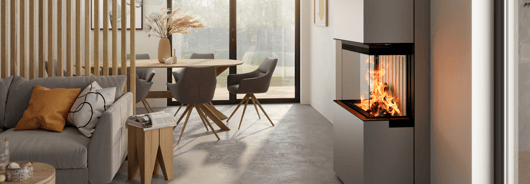
But: exceptions prove the rule!
Are you looking for a special stove that can reduce the distance to the wall? How does an impressive 0 cm distance from the wall sound? Yes, that actually exists!
Our innovative fireplace systems are equipped with extremely space-saving and sophisticated rear thermal insulation and can be installed directly in front of a wall without any clearance. This means they not only blend into your home as a stylish fireplace system, but also merge with your living space in a unique way - for a harmonious and modern ambience without compromising on safety.
.png?width=530&height=184&name=Blogartikel_Kaminzubehoer_1__2560%20(1).png)
Spark protection panels: Fire protection for your wood-burning stove with floor panels
If the floor in front of your fireplace is flammable, the installation of a spark protection panel is mandatory. It is best to seek advice on this from your specialist dealer, who knows your exact circumstances.
A spark protection plate prevents sparks or embers that could fall out of the fireplace from damaging combustible floor coverings such as carpets or wooden floorboards. It must cover an area of at least 50 cm in front of the combustion chamber opening and 30 cm to the side. This provides optimum protection for the surrounding area. You can find the exact dimensions for your model - as well as the safety distances - in the operating instructions.
If the floor in front of the fireplace opening is flammable, the spark protection plate is mandatory.
How you can increase safety beyond this
Also think about heat protection between the stove and furniture or fire protection between the stove and wooden wall
Many wood-burning stoves generate intense heat radiation that can affect neighboring walls, furniture or decorations. It is therefore advisable to set up a "safety zone" around your stove that is free of flammable objects.
In special installation situations, it may be necessary to install radiation protection. It is best to seek advice on this from your local specialist dealer.
Smoke detectors: The guardians in every corner of your home
The installation of smoke detectors is, of course, mandatory. However, this obligation does not usually extend to the living room, where the fireplace is often installed. Accordingly, a smoke detector is often not required by law in these living rooms - but it can still be a good idea to install a smoke detector. As modern wood-burning stoves produce very little smoke, the likelihood of a false alarm is also very low. Simply place the smoke detector a few meters away from the fireplace.
Carbon monoxide detector: Detecting the invisible danger
More important than a smoke detector, however, is a carbon monoxide detector (CO detector) by the fireplace. This is because incomplete combustion of wood or coal can produce carbon monoxide (CO). This is an invisible, odorless and tasteless gas that poses a health risk in enclosed spaces. Although CO detectors are not mandatory, we believe they are a good idea in households with wood-burning stoves.
The carbon monoxide detector should be installed about one meter above the floor and about two meters away from the fireplace. This is because the CO gases are quickly dispersed in the room by the natural air circulation. In addition, at this height you can easily read the measured CO values and also see warnings, which are often triggered before the actual alarm. If the detector sounds the alarm, it is important to leave the room immediately and call the fire department. They will assess the situation and take the correct measures.
Beware of the risk of confusion!
Please note: This is a CO and not a CO2 detector for the fireplace. The CO or CO2 detector for wood-burning stoves is often confused in this context.
Prepared for an emergency: Fire extinguisher within reach
Even with the best precautions, it makes sense to have a fire extinguisher to hand just in case. Foam or powder extinguishers are particularly suitable for use in living rooms with a fireplace. Foam extinguishers are generally less damaging to furniture and technical equipment.
Place the fire extinguisher within reach, but not too close to the fireplace itself. In an emergency, ease of use is crucial. It is therefore worth familiarizing yourself with how it works in advance.
Proper prevention: maintenance, cleaning and regular inspection of the fireplace
For maximum safety and optimum performance of your fireplace, annual maintenance by your specialist dealer is advisable. Your chimney will also be checked by a chimney sweep.
In addition to this annual check, you should also clean your stove regularly yourself. It is particularly important to remove soot deposits.
Soot is mainly caused by incomplete combustion, for example when damp wood or an insufficient air supply impede combustion. So-called glossy soot, a type of stubborn deposit, can ignite when exposed to heat. This is the most common cause of soot fires in the chimney.
You can find important tips & tricks for proper cleaning in our blog post.
Do you have any other questions?
Our competent specialist dealers will be happy to answer any questions you may have about the safety of your fireplace.