



A crackling open fire provides cozy warmth and comfort in winter. But during the heating season, it can be challenging to combine the benefits of a fireplace with a healthy indoor climate. Perhaps you have already noticed that your fireplace creates dry air or that the air quality deteriorates when the fireplace is burning? This mainly affects open fireplaces or models that are not supplied with outside air.
In this article, we show you how to overcome these challenges. Find out how to maintain optimum humidity levels with your fireplace and how often you should ventilate with a fireplace.
What makes an optimal indoor climate?
The right balance of temperature and humidity is essential for you to feel completely comfortable.
- The ideal room temperature: 20 to 22 degrees in the living area. It can be cooler in the bedroom - 16 to 18 degrees ensures restful sleep.
- The optimum humidity level: 40 to 60 percent is perfect for your skin, respiratory tract and general well-being.
You can easily measure the values with a hygrometer and a room thermometer. These measuring devices are often available as combination devices.
How your fireplace affects the indoor climate
Dry air from the fireplace - does the stove reduce humidity?
Fireplace heat is intense and, like any room heating, removes moisture from the air. This is because warm air can absorb more moisture. However, if the humidity drops below 40 %, it can become unpleasant - dry mucous membranes or irritated skin can be the result.
But there are also positive effects: Lower humidity reduces the risk of mold growth. Damp rooms provide ideal conditions for mold.
Poor air quality due to a lack of oxygen
One problem that mainly affects open fireplaces and those without a connection to the outside air is the impairment of air quality.
An open fireplace draws oxygen from the room air to keep the fire burning. At the same time, burning wood produces combustion gases such as carbon monoxide (CO), which can be harmful to health in high concentrations. The oxygen content can drop and the air becomes stuffy, especially during prolonged use.
The combination of a lack of oxygen and pollutants makes regular ventilation of a wood-burning stove essential. This ensures fresh air and reduces pollutants in your home.
To avoid this effect, you should choose modern models that draw their combustion air from outside rather than from the installation room. With these closed fireplaces, combustion gases do not normally enter the installation room.
Fine dust pollution - invisible danger
When heating with wood, fine dust particles can be produced that affect the air quality. This is particularly the case with open fireplaces. In a closed fireplace, the fine dust particles are discharged via the chimney and do not normally affect the installation room. It only becomes problematic if the fireplace is operated incorrectly - for example with damp wood or insufficient air supply. In this case, a particularly large amount of fine dust is produced and fine dust can cause long-term respiratory problems, especially for allergy sufferers or asthmatics.
How to balance the indoor climate
How often should you ventilate a wood-burning stove
Regular ventilation is particularly important for open fireplaces or models that are not directly supplied with outside air in order to improve the air quality. Open the windows wide every two hours and ventilate intermittently for five minutes. This allows fresh oxygen to enter the room and removes pollutants such as carbon monoxide and fine dust. This keeps your indoor climate fresh and pleasant without having to do without the warmth of your fireplace.
Increase humidity with your fireplace
Dry air from the stove is easy to compensate for: place a heat-resistant bowl of water on the stove or use a humidifier to increase the humidity. This allows you to keep the humidity in your fireplace constantly in the optimum range - for a pleasant indoor climate that feels good.
Keep an eye on the temperature
Keep the temperature in your living space between 20 and 22 degrees. Avoid overheating, as this can dry out the air too much. A thermometer helps you to keep an eye on the temperature and adjust your heating output accordingly.
Correct heating for clean air
To minimize fine dust and pollutants, it is important to operate your fireplace correctly. Only use dry wood and make sure that the air supply is optimally adjusted. This not only heats efficiently, but also ensures a fire without smoke and soot.
We have summarized helpful tips and tricks on how to avoid common mistakes with your log fire in a blog post for you.
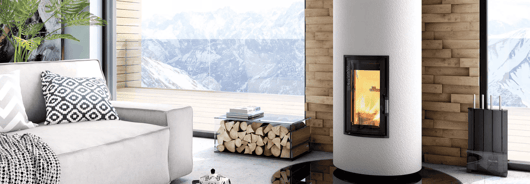
Storage heaters: For a pleasant and even room climate
Storage stoves are an ideal solution for keeping your indoor climate pleasant and constant. Compared to conventional wood-burning stoves, they emit heat evenly and over a longer period of time. Thanks to their storage mass, they absorb the heat from the fire and release it slowly and continuously into the room - even hours after the flames have gone out.
The result: no overheating. The air does not dry out as much and the cozy warmth is gently distributed throughout the room. Storage heaters are particularly suitable for anyone who appreciates a constant and cozy room climate - without having to constantly reheat.
Comfortable warmth without compromise
A fireplace can transform your home into a place of coziness. With simple measures such as regular ventilation and optimum humidity, you can ensure that your fireplace not only provides warmth, but also a healthy indoor climate. Enjoy the benefits of your fireplace and keep your home fresh, warm and inviting - even on the coldest winter days!
You might also be interested in:
 technology & efficiency
Negative Pressure Monitor on the Chimney: Safety with Range Hood & Ventilation System
A fire needs air - and a properly functioning flue is the be-all and end-all. Modern, well-insulated houses put this to ...
 technology & efficiency
Fireplace features: From combustion control to automatic glass opening
A crackling open fire creates a special atmosphere. But hand on heart: sometimes operating a fireplace is associated ...