



Do you also dream of the cozy atmosphere of your own fireplace in your rented apartment, but you're not sure if it's even possible? The short answer is: "Yes and no". But the good news is: it's not impossible or unusual per se! In this article, we've summarized everything you need to know about tenancy law regarding a wood-burning stove in your rented apartment.
We'll take you through the process step by step, explain the legal framework and show you suitable fireplace models. So let's get straight down to business and get one step closer to your dream fireplace.
First, the basics: can a fireplace be installed in every rental apartment?
Unfortunately, no. Not every apartment is suitable for the installation of a classic fireplace. The most important basic requirement is access to a chimney. If there is no internal chimney, an external chimney, which is installed on the outside wall of the house, may be an option. However, this must also be planned professionally and safely. It is best to consult a specialist for this. If there is a chimney, it should always be inspected by a chimney sweep to ensure that a chimney can be operated.
By the way: It is also important to remember that you need sufficient space to store your firewood.
Obtain permission: Convincing the landlord
Before you can let the fire crackle in your living room, you must obtain permission from your landlord. This is especially true if the installation of your fireplace involves alterations to the fabric of the building, such as a new access to an existing chimney. If you make these structural changes without consent, your landlord can issue you with a warning. In addition, the shared use of an existing chimney is usually not specifically regulated. This also requires clear clarification.
It is crucial that you prepare the conversation with your landlord well. Inform yourself thoroughly in advance about the legal requirements and safety regulations.
Here are some advantages that you can emphasize in your conversation with the landlord:
- Increasing the value of the property: a modern fireplace can increase the value of the property and represents a long-term investment for the landlord.
- Aesthetic enhancement: Fireplaces serve as an appealing element of the interior design and increase the attractiveness of the apartment for future tenants.
- Sustainability: A fireplace, especially if it is operated with renewable fuels such as wood, is an environmentally friendly heating alternative.
- Independence from gas and electricity: A fireplace promises additional independence from conventional energy sources.
Tips for talking to the landlord:
- Professional appearance: Appear confident and present well thought-out arguments as well as detailed plans of your project.
- Documentation: Bring plans or pictures of similar installations to demonstrate how the fireplace could look in the rented apartment.
- Proof of safety: Emphasize that all safety standards will be met and implemented by certified specialist companies.
- Flexibility: Be open to adapting to the landlord's ideas or offer to remove the fireplace when you move out, if desired.
- Storage options: It is best to discuss the storage of the firewood directly when making the arrangements. Try to suggest an idea that is as harmonious as possible and does not restrict the landlord.
Legal framework and safety regulations
Before you start the conversation with your landlord, it is important that you inform yourself thoroughly about the legal framework that must be observed when installing a fireplace in a rented apartment. Here are some key aspects:
- Fire safety regulations: Find out about the specific fire safety regulations in your place of residence.
- Distance regulations: There are precise guidelines on how far away a fireplace must be from flammable materials. You can usually find the distances in the technical data for the respective model.
- Approval by the chimney sweep: Before a fireplace can be installed, an inspection must usually be carried out by the chimney sweep; at the latest, however, the installed fireplace must be approved by the chimney sweep before commissioning. This involves checking whether the existing chimney is suitable for the operation of a fireplace or whether adjustments are necessary.
- Planning permission: In some cases, permission may be required, particularly if major alterations are planned. This depends on the local building regulations.
- Maintenance requirements: Regular maintenance and inspection of your fireplace are not only important for safety reasons, but are often also required by law. Find out what obligations apply to you.
- Federal Immission Control Act: The stove must comply with the guidelines of the Federal Immission Control Act and must not exceed a certain level of particulate emissions. When buying, make sure that the manufacturer complies with all necessary DIN and EN standards.
The right stove for your rented apartment
Once the landlord and the chimney sweep have approved the installation of a wood-burning stove, the wide world of fireplaces is open to you. But what is best suited to your home?
The first thing that comes to mind when you think of a fireplace is probably the fireplace insert, which blends harmoniously into the home. However, these are only suitable for apartments to a limited extent. Especially if you live in a rented apartment, it is less likely that you will get your landlord's permission for such a major intervention. It is also more difficult to restore the apartment to its original state or take the fireplace with you when you move. If this is not a problem for you, a fireplace insert can be a good choice. There are endless possibilities for how you can install your fireplace - and the look of a built-in fireplace is unbeatable.
Stoves are particularly suitable for rental properties. These are converted and only need to be connected to a chimney. What's more, you can take them with you when you move house and restore the apartment to its original state more easily. All you have to do is keep a safe distance from walls and other flammable materials. Stoves have become increasingly popular in recent years and the range is now so varied and individual that you are sure to find your perfect stove.
In recent years, some innovations have also conquered the market that are also suitable for smaller homes and at the same time resemble a built-in fireplace in their appearance: the so-called fireplace systems! These are prefabricated fireplaces that can be installed quickly and easily in the living room.
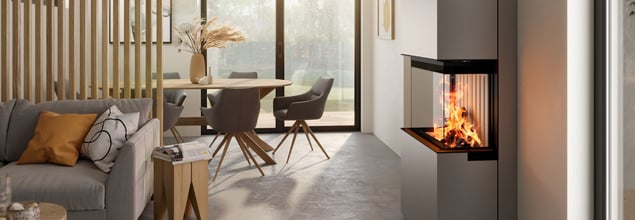
And all within the width of a towel: that's all the space you need. See for yourself and discover our Saphir. Not only is it super narrow and offers an impressively wide fire panorama, it can also be placed directly in front of the wall. Our Saphir actually requires 0 mm clearance from the wall! Isn't that fascinating?
Installing a fireplace without the landlord's permission?
Yes, we have a solution for you! In such cases, fireplaces for apartments that do not require a flue are particularly popular. So if a conventional fireplace is out of the question, electric fireplaces or bioethanol fireplaces could be an alternative. These do not require a chimney and are often less restrictive in terms of installation requirements.

An electric fireplace, for example, can be installed without the landlord's permission as it is considered an electrical appliance. And don't be fooled: Modern electric fireplaces are now available with a deceptively real flame pattern and they can even heat. See for yourself and discover our Virtuo Evolve!
Nevertheless, safety precautions must be taken depending on the model. To avoid heat build-up, the appliance should not be placed directly against a wall. The ventilation openings must also be protected from blockages. And if the electric fireplace is to be installed in the wall, this structural intervention must also be agreed with the landlord.
An ethanol fireplace, on the other hand , should be seen purely as a decorative element. It can be installed in the apartment as an exciting accessory without the landlord's permission. It should only be noted that an ethanol fireplace has no flue and the substances produced during combustion remain in the room. These models should therefore never be operated in a small room and preferably always with sufficient ventilation so as not to pose a safety risk. A CO detector should also be installed if possible to ensure sufficient air quality.
Installation and maintenance
No matter what you choose: The installation of a fireplace should always be carried out by a qualified specialist company to avoid complications and risks. Choosing an experienced specialist dealer also guarantees that all regulations are complied with.
You should also clarify how the installation of a fireplace will affect your home and contents insurance. It is important to clarify all insurance issues before installation in order to be covered in the event of a claim.
We hope that this overview has clarified your questions and that you are well equipped to fulfill your dream of a fireplace.
Our experienced local specialist dealers will be happy to answer any further or more specific questions and prepare you in the best possible way! They will advise you on the legal requirements as well as the various options and models.
You might also be interested in:
 environment & law
Fireplace with a catalytic converter: simply cleaner heating | Spartherm Blog
Are you planning your dream fireplace and want to focus not only on design and performance, but also on meeting the ...
 environment & law
Is heating with a fireplace carbon-neutral?
The topic of CO₂ neutrality is something you hear again and again, especially in connection with wood-burning stoves - ...