



The topic of CO₂ neutrality is something you hear again and again, especially in connection with wood-burning stoves - but what exactly does "CO₂-neutral" mean? And what do I need to bear in mind to ensure that my wood-burning stove is actually CO₂-neutral when heating with wood? Many people rightly ask themselves these questions. After all, you want to enjoy the cozy warmth of the fireplace and act responsibly at the same time.
That's why we explain the CO₂ neutrality of wood-burning stoves in this article and show you how to heat efficiently and in a CO₂-neutral way.
What you can expect
- What does CO₂-neutral mean: explained briefly and clearly
- Wood as a renewable energy source: how the CO₂ cycle works
- Conscious and CO₂-neutral heating: here's how it works
What does CO₂-neutral mean?
In simple terms, CO₂-neutral means that no net additional CO₂ emissions are released into the atmosphere as a result of an activity, product or organization. If something is described as "CO₂-neutral", it does not increase the concentration of carbon dioxide in the atmosphere and does not place any additional burden on the climate.
Important to know: CO₂-neutral does not automatically mean emission-free. CO₂ can certainly be produced - but the decisive factor is that the overall balance is balanced in the end.
To illustrate: although CO₂ is released when wood is burned, only the amount of carbon that the tree previously absorbed from the atmosphere is returned. No "additional" CO₂ is therefore produced when burning wood. Wood is therefore often regarded as part of a natural cycle.
The situation is different with fossil fuels such as oil: Here, CO₂ is produced that was stored over very long periods of time and is now additionally released into the atmosphere. This is why fossil fuels are not considered CO₂-neutral.
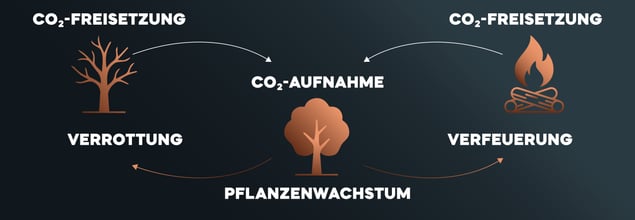
Wood as a regenerative energy source: how the CO₂ cycle works
As we have just seen: When wood is burned, the carbon bound in the wood is released in the form of carbon dioxide (CO₂).
This is because trees absorb CO₂ from the atmosphere as they grow and store the carbon in the wood. When burned, this carbon is released again. As trees would release the same amount of CO₂ into the atmosphere during natural decay, no additional CO₂ is produced by burning wood. Burning wood is therefore CO₂-neutral and does not place any additional burden on the climate.
However, there is still something to consider: A key point for the CO₂ neutrality of wood is sustainable forestry. This means that, in the long term, only as much wood may be removed as can grow back so that the carbon balance in the forest remains even. This means that at least one new tree must be planted for every tree cut down. As they grow, the newly planted trees then absorb the CO₂ that was previously released during combustion. This creates a natural cycle that ensures a balanced CO₂ balance.
 |
Want to heat even more sustainably? No problem! In this blog post, we have put together some tips for you on how you can heat even more sustainably with wood. |
Conscious and CO₂-neutral heating: this is how it works
So is heating with wood always CO₂-neutral? Unfortunately, no. If you not only want to heat with wood for comfort, but also for the most CO₂-neutral combustion possible, two points are particularly important: where your firewood comes from and how efficiently you use the heat generated in your home.
Wood from the region
Even if the wood itself does not emit any additional CO₂ during combustion, factors such as transportation play a role. A simple solution: buy your firewood from a regional supplier. This avoids long transportation routes, saves "unnecessary" CO₂ emissions and supports the local economy at the same time. In addition, regional suppliers often communicate more transparently about the origin of the wood. This way, you can ensure that your firewood comes from sustainable forestry.
But how do you know if the wood comes from sustainable forestry? Certifications such as FSC (Forest Stewardship Council) and PEFC (Program for the Endorsement of Forest Certification Schemes) are a good guide. They guarantee that the wood comes from sustainably managed forests - i.e. from forests that can constantly supply wood without being endangered as an ecosystem.
Therefore, when buying your firewood, make sure that it has one of these certificates if possible and that you source it regionally.
Water-bearing stoves
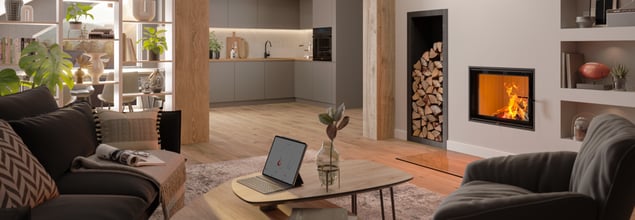
If you are about to purchase a fireplace, want to replace your old stove or want to heat even more efficiently in a CO₂-neutral way, it is worth taking a look at water-bearing stoves.
Water-bearing fireplaces not only heat the room in which they are installed, but also support the central heating system. The advantage for the CO₂ balance: the energy released when burning wood is not "only" used as cozy radiant heat in the living room - it can also be fed into the heating system and thus used more efficiently and in a more versatile way.
Thanks to modern technology, some of the heat energy from the flue gas is temporarily stored in a buffer tank so that it is available for the central heating system with a time delay. In this way, your fireplace can not only support the room, but also the hot water preparation or your room heating throughout the house.
However, it is important to note that a water-bearing fireplace does not make heating "CO₂-neutral". But it does help you to use the heat generated in even more versatile ways.
Have we sparked your interest in a water-bearing fireplace? Our expert specialist dealers will be happy to advise you at any time!
You might also be interested in:
 environment & law
Fireplace with a catalytic converter: simply cleaner heating | Spartherm Blog
Are you planning your dream fireplace and want to focus not only on design and performance, but also on meeting the ...
 environment & law
What requirements must a wood-burning stove meet starting in 2025?
You have made your decision: Your dream of having your own fireplace is finally coming true. But you soon realize: The ...